

Body
For dermatology clinics, visual content plays a unique role in how potential patients evaluate trust and credibility online.
Dermatology clinics often invest significant effort into building detailed service pages on their websites. These pages explain treatments, technologies, and care approaches in depth. However, the Services section of the Google Business Profile (GMB) is frequently overlooked, misunderstood, or incorrectly maintained.
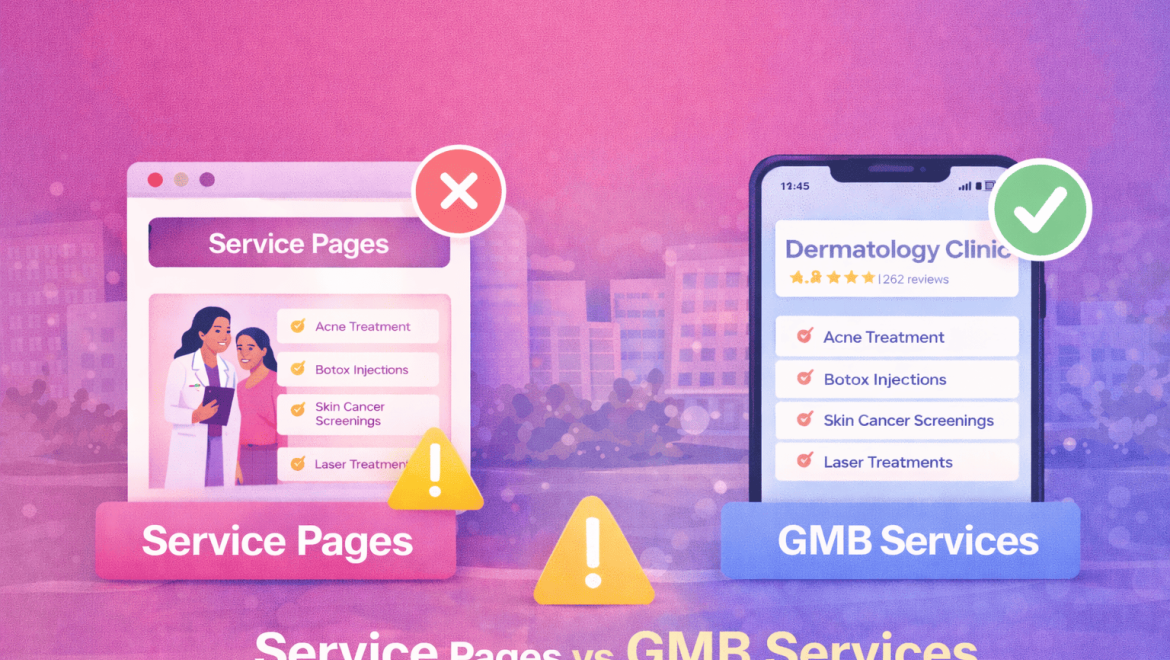
Although both serve the purpose of informing potential patients, service pages and GMB services are not interchangeable. Treating them as the same can limit clarity, consistency, and local visibility.
This blog explains where dermatologists commonly go wrong and why this distinction matters.
Website Service Pages and GMB Services Serve Different Roles
Website Service Pages
Service pages on a dermatology clinic’s website are designed to:
- Educate patients about treatments
- Explain procedures and benefits
- Build trust through detailed content
- Support broader organic search visibility
These pages typically include in-depth descriptions, FAQs, and contextual information.
GMB Services
The Services section on a Google Business Profile has a different purpose:
- Helps Google understand what the clinic offers
- Provides patients with a quick overview of treatments
- Supports visibility in location-based searches
This section is structured, concise, and focused on relevance rather than explanation.
Common Mistakes Dermatologists Make
1. Assuming Website Services Automatically Reflect on GMB
Google does not automatically sync website service pages with the GMB Services section. Many dermatology clinics leave this section incomplete, assuming their website content is sufficient.
As a result, the profile may appear less clear or less relevant for certain searches.
2. Inconsistent Service Naming
Dermatologists often list detailed or branded treatment names on their websites while using generic or mismatched terms on GMB.
This inconsistency can reduce clarity for patients and make it harder for Google to connect services across platforms.
3. Using Promotional Language Instead of Service Clarity
GMB services are sometimes written like advertisements, with marketing phrases or superlatives.
Google generally expects clear, factual service names rather than promotional descriptions in structured profile sections.
4. Not Updating GMB Services When Offerings Change
New treatments may be added to the website, while outdated services remain listed on the Google profile.
Over time, this creates information gaps that can confuse patients and reduce profile accuracy.
5. Mixing Medical and Cosmetic Treatments Without Structure
Many dermatology clinics offer both medical and aesthetic services. When these are listed without logical grouping or clarity, patients may struggle to understand the clinic’s primary focus.
Clear separation helps manage expectations.
Why This Matters for Local Visibility
Google evaluates consistency and relevance across multiple signals. When service pages and GMB services align:
- Patients receive clearer information
- Search systems understand offerings more accurately
- Profiles appear more complete and trustworthy
This does not guarantee rankings, but it supports a stronger local presence.
GMB Services Support - Not Replace - Website Pages
The GMB Services section is not a substitute for detailed service pages. Instead, it acts as a supporting layer that reinforces service relevance and improves local discovery.
Both need independent attention.
Final Thoughts
One of the most common oversights in dermatology marketing is assuming that website service pages alone are enough. In reality, service pages and GMB services must be managed separately, with accuracy and consistency.
Understanding their differences helps dermatologists present a clearer, more reliable digital presence-without relying on claims or shortcuts.